
SSL Certificates
Safe and secure site.
For your business and for your customers.
Web Security Market Leader with more than 1.8 Million SSL Certificates Issued
 Web Security Market Leader with more than 1.8 Million SSL Certificates Issued
Our complete offer. Choose your solution.
 DV CertificatesIdeal for blog and little web sites |
 OV CertificatesIdeal for eCommerce and Companies |
EV CertificatesIdeal for Top eCommerce and High Brand Identity |
WILDCARDIdeal for protect all subdomains |
|
|---|---|---|---|---|
|
4,19 CHF monthly, including VAT instead of "8,37" CHF monthly, including VAT |
6,02 CHF monthly, including VAT instead of "12,03" CHF monthly, including VAT |
12,55 CHF monthly, including VAT instead of "25,09" CHF monthly, including VAT |
19,87 CHF monthly, including VAT instead of "39,73" CHF monthly, including VAT |
|
| Features | DV Certificates | OV Certificates | EV Certificates | WILDCARD |
 Name Name |
SectigoSSL DV | InstantSSL OV | SectigoSSL EV | InstantSSL Wildcard |
|
Validation type |
Domain Validation |
Organization Validation |
Extended Validation |
Organization Validation |
|
HTTPS |
1 domain | 1 domain | 1 domain | All Subdomain |
|
Guarantee |
 |
|
|
|
|
Server License |
Unlimited | Unlimited | Unlimited | Unlimited |
|
Company Certification |
 |
|
|
|
 GDPR compliant GDPR compliant |
|
|
|
|
| More Info | DV Certificates | OV Certificates | EV Certificates | WILDCARD |
|
Cryptography |
SHA-256 | SHA-256 | SHA-256 | SHA-256 |
|
CA ROOT |
Sectigo | Sectigo | Sectigo | Sectigo |
|
Trust Logo |
 |
 |
|
|
|
Issuance Time |
Immediate | 1-2 days | 1-2 days | 1-2 days |
|
Sitebuilder compatible |
|
|
|
|
Choose the best. Look at our SSL.
Domain Validation
Domain Validation
The ideal SSL certificate to protect a site in HTTPS, with support for installation and warranty in the event of compromise. SSL 123 is a high quality certificate at an attractive price, used for simple verification that the applicant is the domain owner.
Recommended for blogger and small websites

Organization Validation
Organization Validation
The SSL certificate is for e-commerce and businesses, ideal to guarantee safe transactions for all users. This type of certificate is released after a careful analysis of the applicant company in order to ensure reliability.
Recommended for eCommerce and companies

Extended Validation
Extended Validation
The Web Server EV certificate, thanks to the green bar containing the name of the applicant company, supplies its visitors with the maximum guarantee on the identity of the site and reliability of the company. It is the certificate recommended for large e-commerce businesses and companies looking to assert their Brand Identity.
Recommended for
big eCommerce and companies
Do you want to protect all your subdomains? Discover Wildcard
All SSL certificates include
Free
re-release
Free
re-release
You can re-release your SSL certificate in your control panel anytime.

International domains
International domains
Lots of TLDs from all over the world.

Risk
coveragee
Risk
coveragee
Your business always safe, thanks to a dedicated insurance.

Renewal reminder
Renewal reminder
You will be notified when your SSL certificate is about to expire.
How to recognize an SSL-certified website
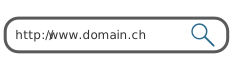
Not secure
Not secure
A non-SSL-certified website can be recognized by the absence of the padlock symbol to the left of the Internet address, and so a secure connection to visitors cannot be guaranteed, especially with regard to data transfers such as those entered through Contact Forms, User Authentication, Payments, User Registration. In addition to jeopardizing the credibility of your business, this also penalizes your website’s visibility as Google assigns greater value to SSL-certified websites by privileging them in search results over their competitors.
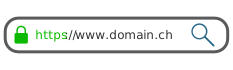
Secure
Secure
A green padlock to the left of the Internet address identifies a website which has an active and correctly installed SSL Certificate. In addition to validating the website, this also provides a guarantee of reliable and secure communication between the visitor and the website via encrypted HTTPS protocol. Data transferred through communication forms, whatever it may be (personal data, access credentials, credit cards…), are encrypted and cannot be intercepted by anyone.
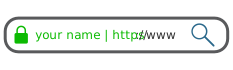
Highly reliable
Highly reliable
When the company name naappears in green between the padlock and the Internet address, it means that website has an Extended Validation (EV) SSL Certificate. This type of certificate is issued following a very thorough company verification process that is requested by the Certification Authority and distinctly confirms that the website has a solid structure. This provides visitors with the maximum guarantee of website identity, company reliability, product reliability and data transmission security and increases brand prestige and value.
How to enable the SSL certificate

Access the control panel
Access the control panel
After purchasing, access the Register.it Control Panel. You will find your SSL certificate in the "Products to activate" section. Follow the Wizard to obtain the SSL certificate emission.

Certificate Emission
Certificate Emission
Once you have inserted the previously created CSR, you will need to select the webserver type where the SSL certificate will be installed and confirm email and administrative contact information. Depending on which certificate is chosen (domain or organization validation), you will be sent a confirmation email or will receive a call on the number you indicated.

Certificate installation
Certificate installation
Once you have obtained the certificate, you can install it on your server hosting space. Refer to your server documentation or product administration panel for further details on how to enable HTTPS protocol and install the certificate.


What about Swizzonic?
Part of  , leader in digital services in Europe